Brigham Young
Under the Banner of HeavenBrigham Young becomes the decisive successor to Joseph Smith at a moment when the Latter-day Saints faced both a leadership vacuum and renewed danger. Where Joseph’s authority rested on charisma and frequent revelation, Young’s rested on organization, discipline, and an insistence on obedience. He led the Saints out of Nauvoo and into the Great Salt Lake Valley, then used church and territorial institutions to defend their autonomy. The account presents that achievement alongside its costs: the hardening of an embattled community, conflict with federal authority, and Young’s later effort to make John D. Lee bear responsibility for the Mountain Meadows massacre.
Succession and a Different Kind of Leadership
Joseph Smith’s death left the church divided over both leadership and plural marriage. Many of the Twelve Apostles, including Young, were away campaigning for Joseph’s presidential bid; Young was in Massachusetts and learned of the killing nineteen days afterward. He returned to Nauvoo with the other apostles as anti-polygamy leaders tried to secure the succession before they arrived. Sidney Rigdon had maneuvered to become guardian of the church, while the sudden death of Samuel H. Smith further unsettled the contest.
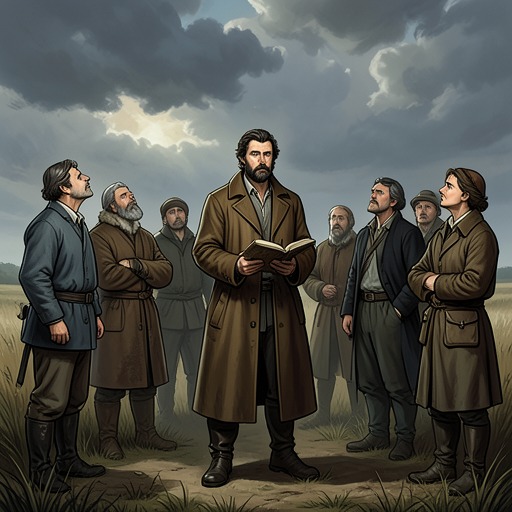
On August 8, 1844, Rigdon and Young each addressed the assembled Saints. Rigdon spoke for ninety minutes, but failed to persuade the gathering that he was God’s clear choice. Young then spoke in a manner that witnesses later described as resembling Joseph in voice and bearing. John D. Lee recalled that some believed Joseph’s mantle had fallen upon Young; other Saints reported a striking transformation as Young addressed them. The account treats the episode as a pivotal moment of recognition: the assembly largely accepted Young, and he became the church’s second president and prophet.
The contrast with Joseph helps explain why this succession mattered. Joseph was described as tall, charismatic, impulsive, and prolific in receiving revelations; Young was shorter, pragmatic, and attentive to organization. He had far fewer canonized revelations, and the one identified in the account dealt with organizing wagon trains rather than sacred mysteries. The book’s judgment is that the Saints, facing the threat of extermination after Joseph’s death, needed firm leadership and discipline more urgently than religious invention. Young supplied those qualities, earning the description “the American Moses” from George Bernard Shaw.
Exodus and the Making of a Community
As violence against the Saints in Illinois intensified, Young concluded that they could not remain near Hancock County. In a letter to Governor Thomas Ford’s committee on September 24, 1845, he offered to take the Saints out of Illinois and the United States in return for a cease-fire. The parties agreed, giving the community time to prepare for departure. Young and his counselors selected the Great Basin as a remote refuge, after considering Oregon, California, and Vancouver Island.
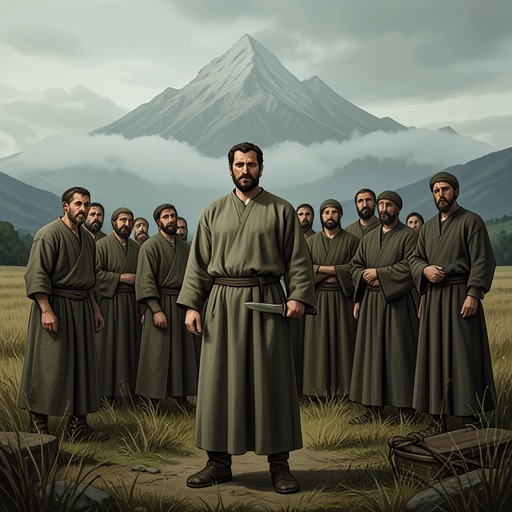
The migration began in winter. On February 4, 1846, the first emigrants crossed the Mississippi River from Nauvoo into Iowa. By May, more than six thousand Saints were moving west. The thirteen-hundred-mile journey brought frostbite, disease, hunger, stillborn infants, hostile encounters, and the deaths of more than six hundred people during the first winter. Young’s management proved critical to keeping the migration moving. On July 21, 1847, an advance party saw the Great Salt Lake Valley; the following day, with Porter Rockwell leading, it descended through Emigration Canyon. Young arrived with the main company on July 24, weak from tick fever. Before sunset, the Saints had planted potatoes and diverted City Creek for irrigation, while beginning the work that would grow into Salt Lake City.
The journey did more than relocate the church. The account argues that its hardships, together with earlier persecution in Missouri and Illinois, strengthened the survivors’ loyalty to one another and to Young. Those who completed the exodus were bound by a shared ordeal, and the resulting allegiance to their leader was described as unconditional. At Sugar Creek, Iowa, after the emigrants had crossed beyond the reach of Illinois vigilantes, plural marriage was openly disclosed to ordinary members for the first time. Young and his counselors nevertheless continued to deny the practice to outsiders, a contradiction the book identifies as “Lying for the Lord.”
Territorial Power and Plural Marriage
Young’s authority took institutional form after the Saints settled in the Great Salt Lake Valley. Following the United States’ annexation of Utah, he declared allegiance to the republic and sought statehood as a way to secure local sovereignty. Instead, Utah became a territory in 1850, with Young appointed governor. The arrangement formally placed the territory under federal oversight, but the book describes Young and the Mormon-dominated legislature as seeking to preserve a wide measure of church control.
Plural marriage became a public test of that control. On February 4, 1851, Young acknowledged to the territorial legislature that he had many wives. In 1852, he publicly presented the practice as a religious doctrine associated with Joseph Smith’s revelation on celestial marriage. The announcement shocked converts in Europe and contributed to a sharp decline in immigration; one missionary reported that 1,776 British Saints left the church within six months. Many Utah Mormons, by contrast, accepted plural marriage as an ideal, even though only a minority practiced it. Young urged the faithful to accept the doctrine and argued that the government had no right to interfere with religious practice.
For Young, divine law took precedence over the laws of non-Mormon authorities. The territorial legislature, dominated by members of the Church of Jesus Christ of Latter-day Saints, expanded the authority of local probate courts, which Young controlled, at the expense of federal jurisdiction. Mormon bishops commonly served as probate judges, and church members made up most juries. Federal officials complained that the territory had become a theocratic dictatorship; many also faced persistent harassment and left. In the book’s account, this system was not simply a dispute over a religious belief. It was a contest between overlapping legal orders, each claiming authority over marriage, courts, and public life.
Federal Confrontation and Mountain Meadows
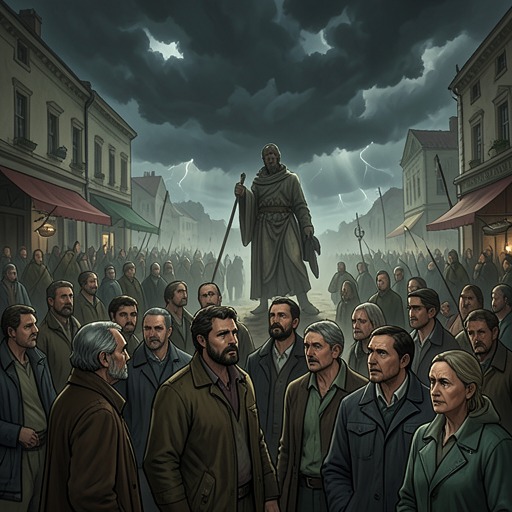
The conflict reached a national scale in 1857, when President James Buchanan sent federal officials to replace Young as territorial governor and ordered twenty-five hundred soldiers to escort them to Salt Lake City. The Utah War ended in a negotiated settlement before either side fired a shot. Yet the crisis formed the backdrop to the Mountain Meadows massacre, and the book connects the larger atmosphere of confrontation with the violence that followed in southern Utah.
The account records Young’s meeting with Paiute chiefs in Great Salt Lake City on September 1. With Dimick B. Huntington interpreting, Young gave the chiefs the emigrants’ cattle along the Old Spanish Trail. According to Huntington’s notes, the message was that Young wanted the Paiutes to attack the Fancher wagon train. The following morning, the chiefs rode south. This evidence places Young’s words and actions within the lead-up to the attack, while the account separately traces the orders and actions of local leaders and participants.
In May 1861, Young encountered the memorial erected over the victims’ remains. After reading its inscription, he proposed changing its wording to “Vengeance is mine, and I have taken a little.” One of his party then pulled down the cross, and others dismantled and scattered the stones. By the time Young’s group left, the monument had been obliterated. The episode makes the memorial itself a point of conflict: the attempt to preserve a public marker of the killings ended in its deliberate destruction.
Lee, Responsibility, and Legacy
Years later, after John D. Lee’s first trial ended without a conviction, public pressure for justice intensified. The book describes Young as abandoning the claim that the Paiutes were responsible and choosing instead to blame Lee, his adopted son. At the second trial, in 1876, the First Presidency screened an all-Mormon jury so that Lee alone would be convicted. Jacob Hamblin supplied testimony that the account identifies as perjured; the jury found Lee guilty of first-degree murder, and he was sentenced to death. The narrative presents this as a calculated sacrifice that offered the appearance of justice while placing the burden of a wider crime on one man.
Young’s legacy in the book rests on the tension between effective leadership and concentrated power. He organized a perilous migration, established a lasting center for the Saints, and maintained a community whose members had endured years of displacement and violence. He also defended church authority against civil law, oversaw a territorial system designed to privilege Mormon control, and appears in the account’s examination of events before and after Mountain Meadows. His rise answered the immediate question of who could lead the Saints after Joseph Smith; the institutions and choices that followed made that answer consequential far beyond the succession crisis.